Stress Free School
Ensuring that students across high school are able to deal with stress and display their full potential.
About the Website
As students transition into the later stage of school, they are often bombarded with the sudden increase of workload.
Though there are students who become accustomed to the workload brought about by high school, for a large amount, the stress ends up piling up to the point where it affects their emotional and physical well-being.
Though stress is a topic often discussed in academic settings, it's never a topic that is explored in depth.
The aim of this website is to investigate stress, the different levels of it among high schoolers, and potential solutions.

(ASU Prep Digital)
What is Stress?
Stress is a natural human reaction to changes or challenges (called stressors) which trigger physical and mental responses.
It can be positive through ways such as but not limited to:
- Helping the body adjust
- Keeping alert
- Improving motivation
- Being ready to danger or demands
A well-known example of positive stress is the stress before an important test helps you stay awake and focused.
Types of Stress
- Acute Stress: short-term stress that comes and goes quickly which can be positive or negative. These include riding a rollercoaster or having an argument.
- Episodic Acute Stress: frequent acute stress episodes without enough time to relax. This is common in high-stress jobs like healthcare.
- Chronic Stress: long-term stress lasting weeks or months due to ongoing issues like marital problems, work issues, or finances.
It requires management to prevent health problems.
Symptoms and Causes
- Physical:
- exhaustion
- chest pain, aches
- digestion problems
- Psychological:
- depression
- anxiety
- irritability
How Stress Affects the Body
If an individual is too stressed, the autonomic nervous system, a major neural pathway, gets activated.
The autonomic nervous system controls heart rate, breathing, vision changes, etc., as part of the body's built-in "fight-or-flight" stress response. This means that chronic stress may lead to continuous activation of this response, slowly resulting in wear and tear on the body. Prolonged stress can then lead to multiple symptoms of the above, whether it be physical or psychological (Cleveland Clinic).
How Might It Impact High Schoolers?
As high school students progress, the workload significantly increases along with them. Along with high school introducing more rigorous material to prepare students for college, the pressure on students to excel is amplified as a result of challenging coursework and competition regarding college admissions.
Though this may seem temporary, school stress that remains unmanaged can have lasting effects that extend into adult life. Teens who experience chronic stress in high school tend to struggle in developing healthy coping mechanisms, therefore using maladaptive coping strategies like avoidance, denial, or even substance abuse. These negative coping mechanisms threaten emotional well-being and can harm the overall quality of life later on if unmanaged (Claney).
Research
In order to fully understand the prevalence of academic stress, it’s important to send out a survey to gather information from different grade levels.
The data for each grade will then be looked over to see the impacts of stress for each level of high school and be represented visually, therefore quantifying the prevalence of stress.
All survey questions and their respective graphs will be shown below, as well as any clarification as to what the question was asking and any needed analysis.
Stress Levels Among High Schoolers
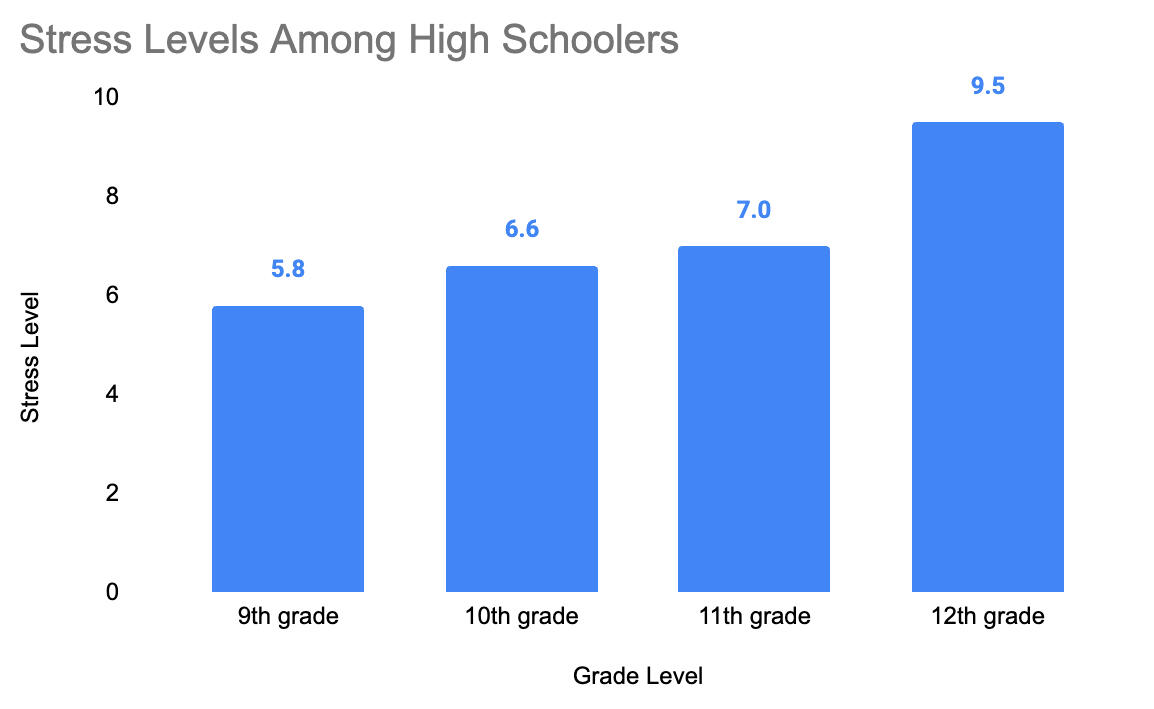
Survey recipients were asked to rank their stress levels from 1 to 10, with 1 being none and 10 being extremely intense.
Key Trends
The graph indicates a clear upward trend, with the lowest stress levels being at 5.8 in 9th grade and the highest being 9.5 in 12th grade.
This graph suggests that seniors face near-maximum stress as a result of a multitude of factors.
Analysis Insights
This graph suggests that seniors face near-maximum stress in comparison to other grades as a result of a multitude of factors.
Frequency of High Schoolers Feeling Overwhelmed by Stress
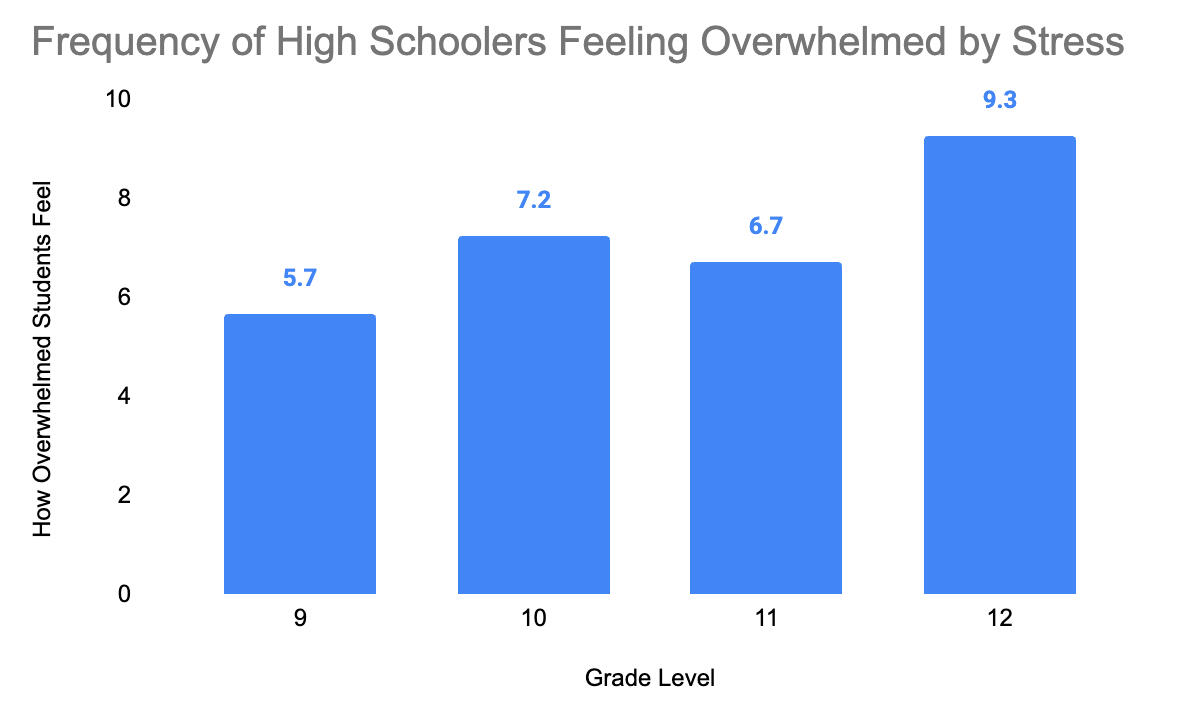
Survey recipients were asked to rank how overwhelmed they feel as a result of stress from 1 to 10, with 1 being not at all and 10 being intensely overwhelmed.
It's important to note that overwhelm from stress differs from stress levels. Overwhelm may lead to inaction and brain fog unlike general stress levels, directly harming academic performance.
Key Trends
The graph indicates a general upward trend for the first two grade levels, but a sudden drop from 7.2 to 6.7 occurring for grade 11 and an increase of 2.6.
Analysis Insights
This could be due to 11th graders becoming more accustomed for stress, until being met with more nerve-racking factors (future plans, IBDP, finals) in grade 12.
Stress Levels During School
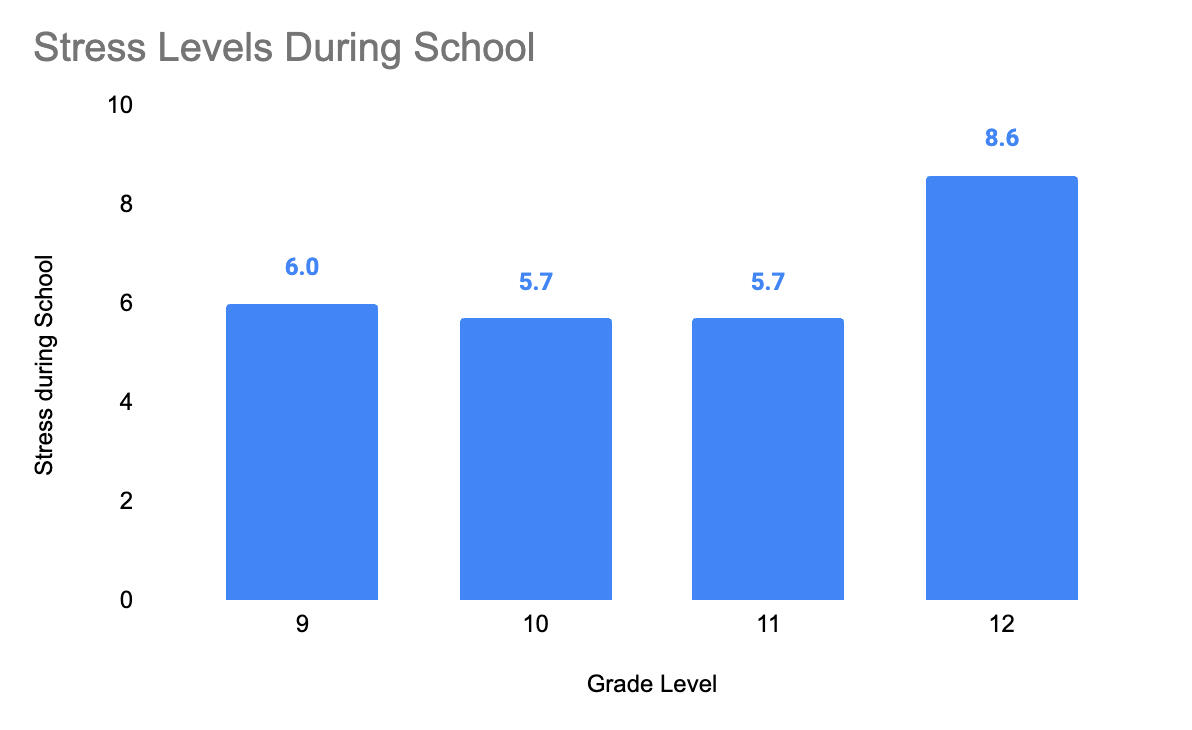
Survey recipients were asked to rank how overwhelmed they feel during an average school day from 1 to 10, with 1 being no stress and 10 being extremely intense stress.
It’s important to note that stress at school differs from regular stress levels. The question only accounts for stress felt during school hours, which is dependent on the environment of the school itself.
Key Trends
The graph starts at 6.0 in 9th grade and decreases to 5.7 for 10th and 11th, until it has a sharp and sudden increase to 8.6 at grade 12.
Analysis Insights
The stress at school being higher in 9th grade could be as a result of the sudden workload MYP brings, whereas the sudden increase in grade 12 could be due to major future planning as well as intensified academic pressure (e.g. exams and DP requirements) in the final year of high school.
Main Sources of Stress
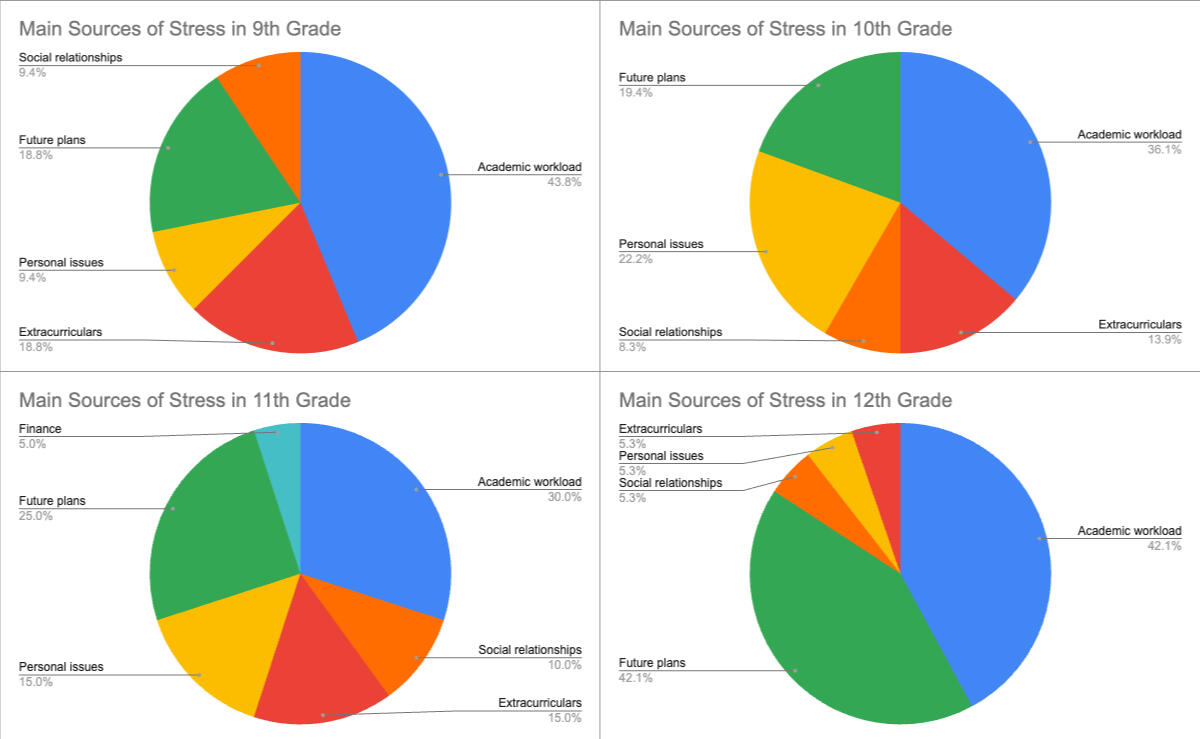
Survey recipients were asked to select all of the main sources of stress that apply to them.
These include academic workload (homework, tests, projects), personal issues, future plans (college, career), social relationships, extracurriculars, and other.
Key Trends
In all four graphs, academic workload is the highest percentage (30% - 43.8%), with future concerns rising from merely 9.4% in 9th grade to 42.1% in 12th grade and social relationship declining and reaching 5.3% in 12th grade.
Analysis Insights
As high school goes on, students typically become more stressed about their future plans and academic performance as it increases in importance whereas anything unrelated (e.g. personal issues, social relationships) stays stagnant or declines.
Main Sources of Academic Workload
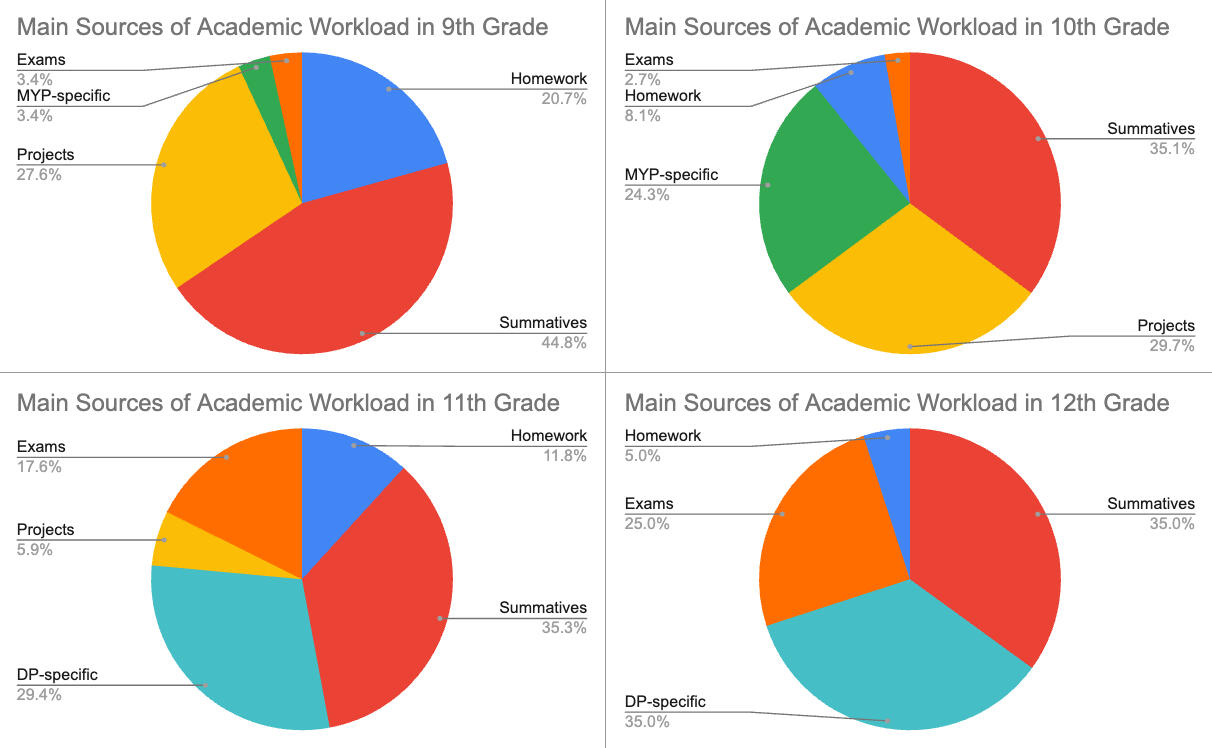
Survey recipients were asked to select all of the main sources of academic workload that apply to them.
These include homework, summatives, projects (e.g. long-term summatives, personal project), MYP-specific (personal project), DP-specific (IAs, EE, TOK, etc.), and exams.
Key Trends
In all four graphs, summatives maintain the highest percentage, but decline from 44.8% to 35.0%. MYP-specific and DP-specific increase from 3.4% to 35.0% along with exams increasing from 3.4% to 25.0%, whereas homework decreases from 20.7% to 5.0%.
Analysis Insights
Due to MYP5 and IBDP having specific requirements, they become a large source of academic workload for students, as well as the amount of summatives and the frequency of them increasing over time.
Impacts of Stress
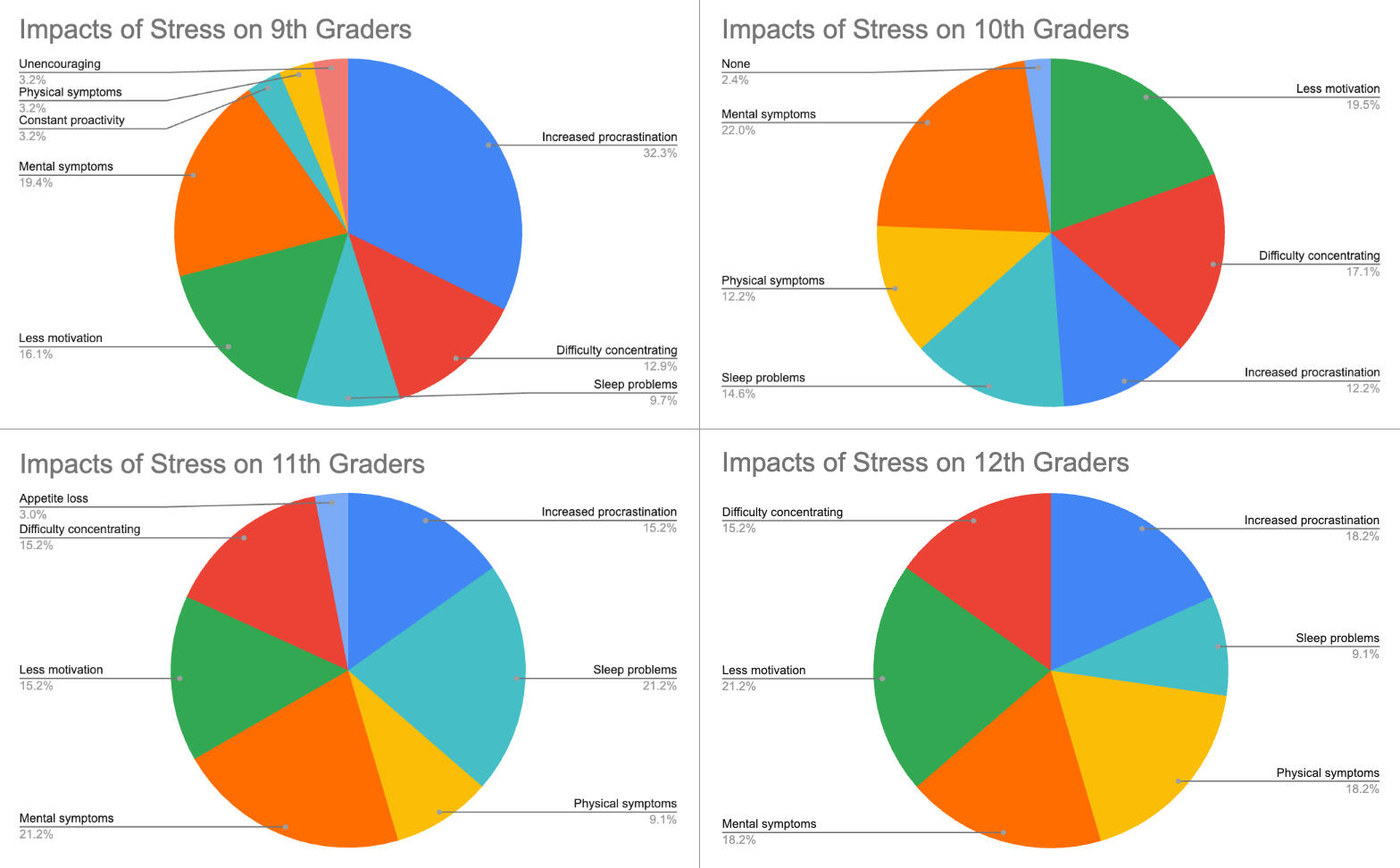
Survey recipients were asked to select all the ways in which stress may impact their lives.
These include difficulty concentrating, increased procrastination, sleep problems, physical symptoms (headaches, stomachaches), mental symptoms (anxiety, irritability), less motivation, and other.
Key Trends
In all four graphs, mental symptoms generally maintain one of the highest percentages (27.8% - 37.3%), along with increased procrastination (15.4% - 25.9%) and less motivation (15.2% - 21.2%). Sleep problems rise from 14.3% in 9th grade to 22.2% in 12th grade and physical symptoms rise from 3.2% to 18.2%.
Analysis Insights
Mental symptoms dominating across all grades indicate stress's toll on mental health, which is also worsened by the increase of procrastination. The increase of physical problems in 11th and 12th also indicate the intense overwhelm faced by DP students as a result of stress, to the point that it leads to physical issues.
Coping Strategies for Stress
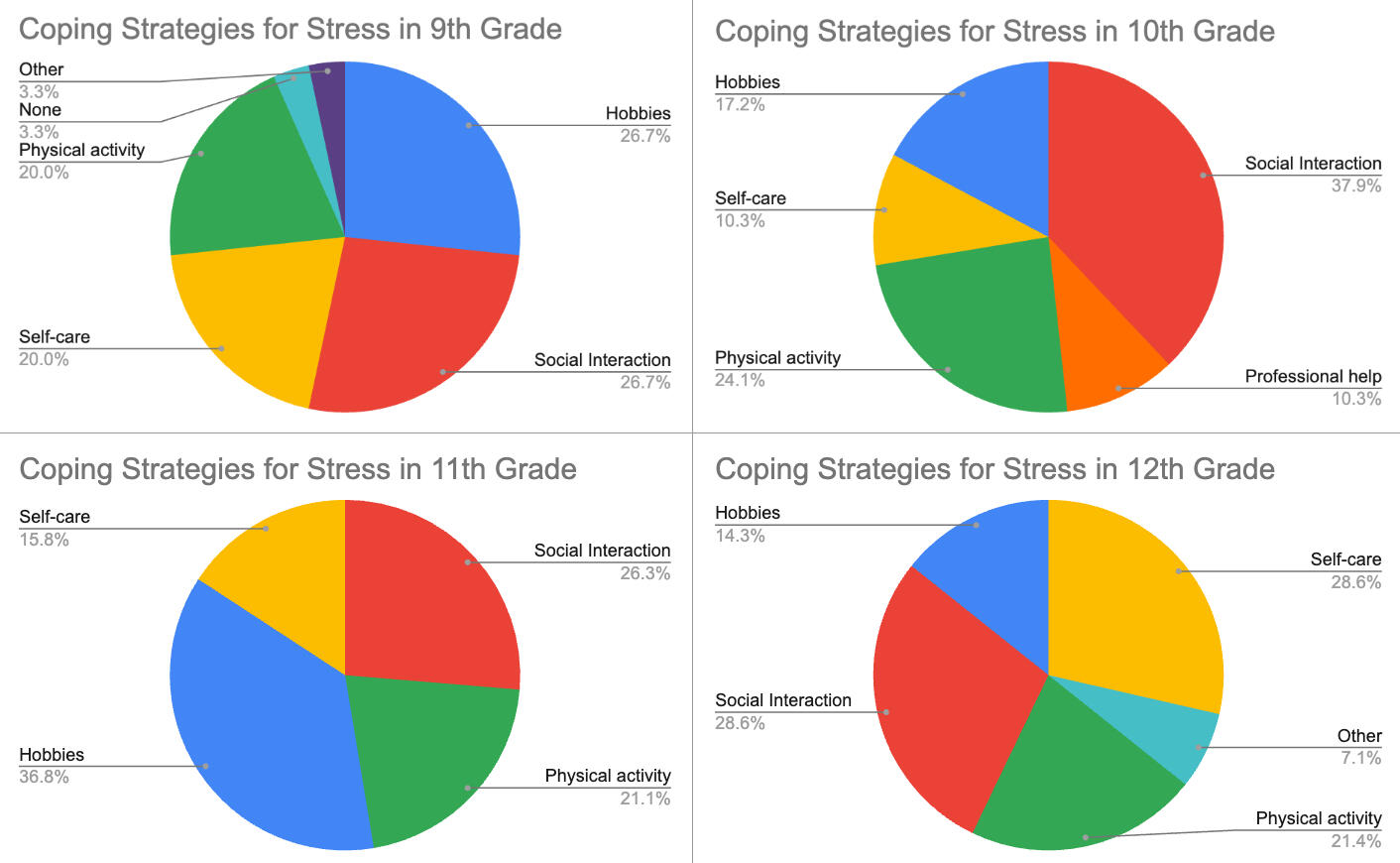
Survey recipients were asked to select all of the coping strategies that they use to manage stress.
These include talking to friends/family, physical activity, hobbies, self-care, professional help (e.g. counseling), and other.
Key Trends
In all four graphs, social interaction tends to maintain a generally high percentage (26.3% - 37.9%) along with hobbies (14.3% - 36.8%) which greatly declines in 12th grade. Physical activity stays generally stagnant (20.0% - 24.1%), with its peak being in 10th grade, whereas self-care decreases from 20.0% to 10.3%, but then has a sharp increase from 15.8% to 28.6%.
Analysis Insights
In grade 9 and 10, students use a balanced range of coping strategies, with a greater reliance on social interaction and physical activity in grade 10. As workload and future-related stress intensifies in grade 11, students utilise hobbies. In grade 12, peak academic demands lead to students prioritizing self-care and social interaction due to lack of time for hobbies.
Impacts of Stress on Academic Performance
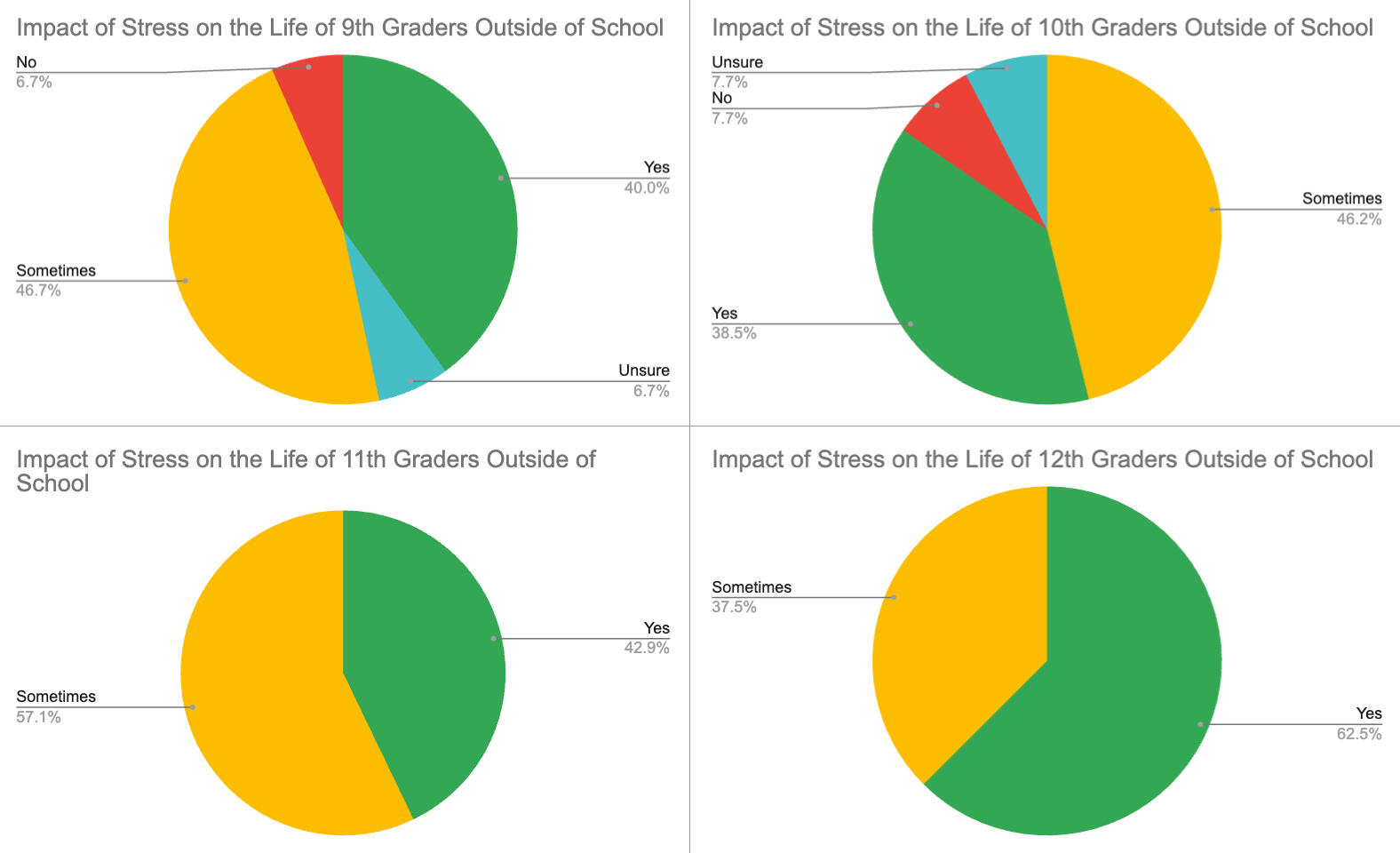
Survey recipients were asked if they feel as if the stress they experience impacts their life outside of school.
The possible answers included yes, no, sometimes, and unsure.
Key Trends
In the first three graphs, the highest percentage was maintained by "sometimes" (46.2% - 57.1%). In grade 9 and 10, 6.7% to 7.7% answered "no", whereas in grade 11 and 12, the percentage decreased to 0%.
In grade 12, "yes" has the highest percentage of 62.5%, whereas only 37.5% of students believe stress only sometimes impacts their life outside of school.
Analysis Insights
As high school goes on, the impacts of stress increase as a result of workload increasing.
In 9th-11th grade, the majority of students report that stress only impacts their life outside of school sometimes, whereas in 12th grade, the majority of students believe that stress frequently impacts their lives outside of school.
Coping Strategies for Stress
Survey recipients were asked if they feel as if the stress they experience impacts their life outside of school.
The possible answers included yes, no, sometimes, and unsure.
Key Trends
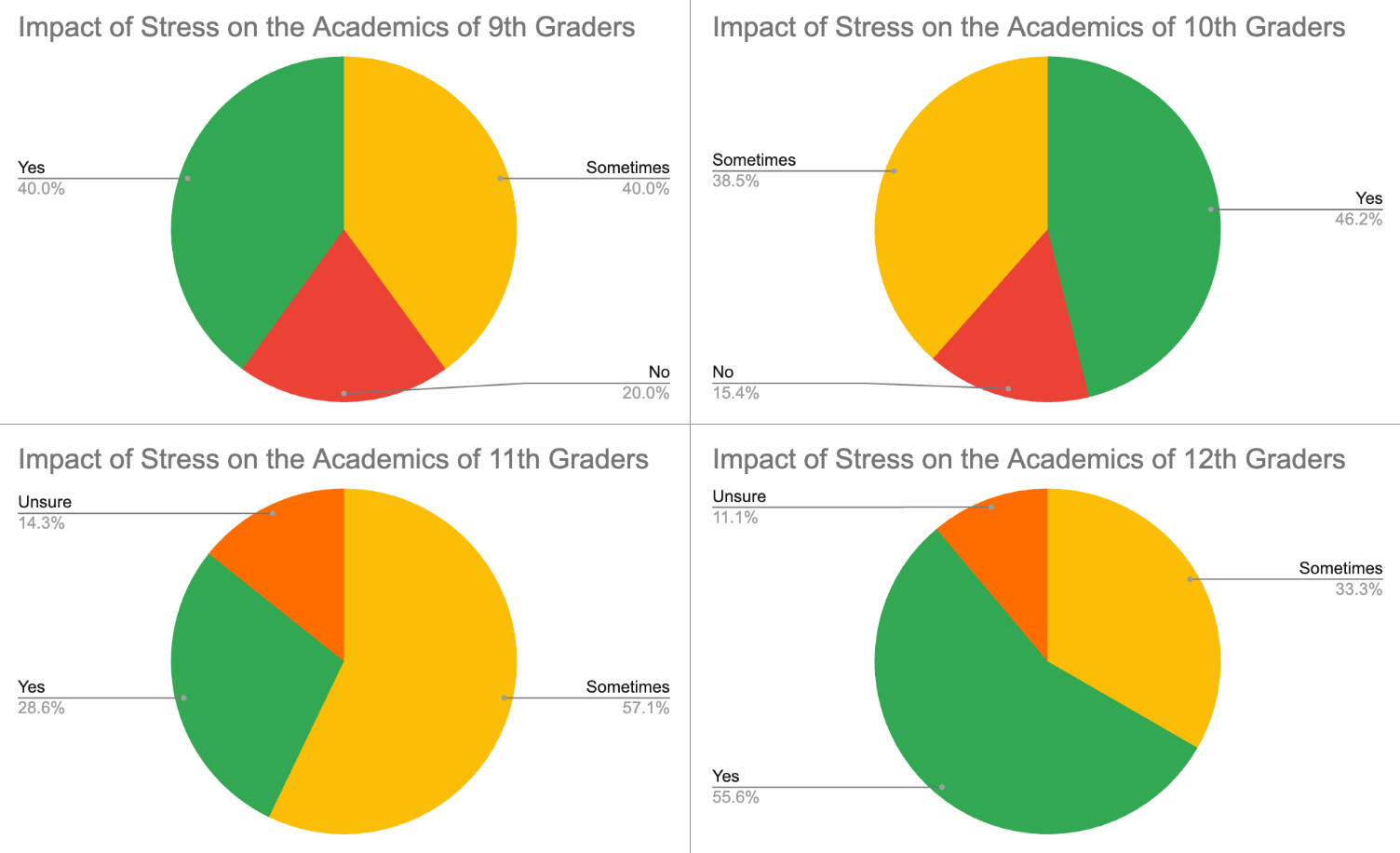
In 9th grade, the percentages for "yes" and "sometimes" are tied at 40.0%, with "no" decreasing from 20.0% in 9th grade to 15.4% in 10th grade. In 11th and 12th grade, "unsure" replaced "no". "Sometimes" dominates 11th grade at 57.1%, but then declines to 33.3% in 12th grade, with "yes" being the highest percentage at 55.6%.
Analysis Insights
Due to lower academic pressure in grades 9 and 10, students are more evenly balanced between stress sometimes affecting their academics and mostly affecting them, including a portion of students which report no impact. As academic demands increase in grades 11 and 12, the impact of stress intensifies, with grade 11 showing frequent impact and grade 12 showing a shift towards stress consistently affecting academic performance.
Coping Strategies
Although stress in high school may seem overwhelming, it's important to adopt coping strategies in order to manage stress in a healthy manner.
This is crucial in maintaining focus, emotional well-being, physical well-being, academic performance, and allowing for free time even when school gets demanding!
Though any strategy can be effective for any grade, some coping mechanisms work better for specific grades in comparison to others. The following section outlines coping strategies for each grade in high school.
9th Grade
As 9th graders transition into high school, the workload greatly escalates, leading to students feeling overwhelmed from the transition. This leads to increased procrastination, mental symptoms, and decreased academical performance.
In order for 9th graders to cope with stress, it's important to use coping mechanisms that allow for transition and adjustment.
Time Management: It's important to build the foundational habit of time management through ways such as but not limited to:
- Using daily planners to schedule homework, summatives, and free time in order to enhance productivity early on.
- Using the pomodoro method when studying or doing homework to seperate work into smaller chunks whilst also allowing for breaks in order to manage time effectively.
Seeking Help: If any academic problems arise it's important to seek help from teachers or counselors early on.
Routine Building: It's important to build a healthy routine early on through ways such as but not limited to:
- Establishing a consistent sleep routine of at least 8-10 hours.
- Balancing free time and studying in order to get work done but also reduce stress.
- Dedicating time to stress-relief habits like light physical activity, hobbies, and journaling.
Setting Timelines: It's crucial to set timelines for long-term assessments (e.g. personal project) to break assessments into smaller chunks and prevent academic overload and procrastination.
Peer Support: Collaborating with classmates through study groups can make doing assignments easier, as well as allowing for more support, increasing motivation, and reducing procrastination.
Balanced Schedule: It's important to keep a balanced schedule, similarly to 9th grade. This includes updating it often in order to avoid procrastination.
10th Grade
10th grade is the year in which academic demands increase, along with the personal project coming into play.
This leads to increased stress overall, as well as more mental symptoms and lack of motivation.
In order for 10th graders to cope with stress, it's important to use coping mechanisms to help deal with the increase of academic workload.
11th Grade
As 11th graders begin IBDP, the workload immediately increases as they're met with an increased amount of summatives along with DP requirements. This leads to more work having to be put in, which can cause sleep problems and more physical and mental problems
In order for 11th graders to cope with stress, it's important to use coping mechanisms that target high workload.
Advanced Time Management: Utilise more planning systems, along with embedding overlapping deadlines into them and managing DP requirements.
- Make an hourly planner allowing for breaks, as well as integrating the pomodoro timer into it.
Balanced Schedule: Allow for a balanced hourly schedule that gives time for self-care and hobbies to reduce stress.
Prioritisation: Prioritise tasks in terms of urgency and impact and allocate time based upon those factors.
Physical Well-Being: Maintain physical well-being through ensuring a consistent sleep schedule, balanced nutrition, and regular physical activity to maintain concentration and emotional regulation when stress is high.
Long-Term Planning: It's crucial to create a detailed revision timetable that accounts for factors such as but not limited to:
- Summatives and assignments
- Any IBDP requirements
- IB exam dates
- University application deadlines
- Personal commitments
Deadline Optimization: Complete and submit assessments and work before deadlines to reduce cognitive load and any procrastination that may arise.
Emotional and Academic Support: Seek out feedback and help from from teachers, counselors, peers, and family when stress becomes too overwhelming.
Cognitive Improvement: Develop a healthy and realistic mindset that strives for progress rather than perfection to avoid burnout.
12th Grade
12th grade is the final year of high school, meaning that it's the year when stress peaks and students finalize their future plans.
This leads to near-maximum stress, as well as a combination of burnout, physical symptoms, mental symptoms, and sleeping problems.
In order for 12th graders to cope with stress, it's important to introduce strategies that involve heavy academic workload and planning.
Resources for Stress Management
Pomodoro Method: A method that breaks tasks into chunks by setting a timer for 25 minutes (working period) and a timer for 5 minutes right after (break period).
Notion: A digital workspace and productivity app/website that allows for customized pages to be created for taking notes, project management, timetables, planners, to-do lists, etc.
Todoist: An app that works as a task management tool for organizing assessments and setting priorities.
MyStudyLife: A website/app that works as a planner designed for students in mind. It can be used for tracking schedules, assignments, homework, etc., in order to reduce last-minute cramming and procrastination.
Created by Ana Barbakadze